GUTSCHEIN
Bitte haben Sie einen Moment Geduld, wir legen Ihr Produkt in den Warenkorb.
Diese Produkte könnten Sie auch interessieren:
Bitte haben Sie einen Moment Geduld, wir legen Ihr Produkt in den Warenkorb.
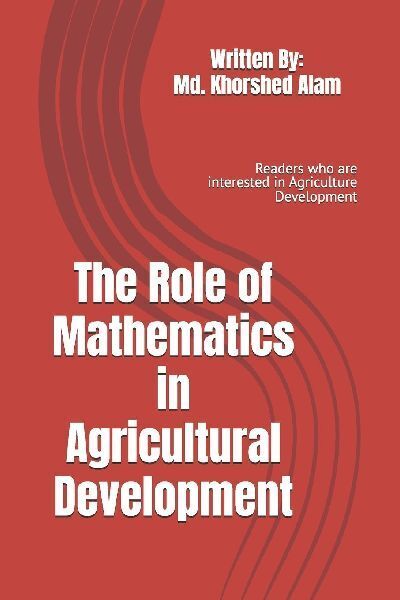
Mathematics forms the backbone of agricultural development, providing the tools to enhance productivity, efficiency, and sustainability across all stages of farming. From the earliest days of cultivation, humans relied on quantitative reasoning to measure land, calculate seed rates, and estimate harvest yields, laying the foundation for systematic agricultural planning. Over time, as agriculture evolved, mathematical principles became integral to scientific research, crop management, and farm economics. Chapters 1 through 10 of the book trace this evolution, emphasizing the role of numbers, measurements, and calculations in basic farming operations such as land assessment, soil testing, irrigation planning, and crop monitoring. Accurate measurements, geometric calculations, and proportional reasoning ensure optimal allocation of resources like water, fertilizers, and labor, while also providing reliable forecasts for expected yield. Early integration of statistics, probability, and basic algebra in field trials allows farmers and researchers to analyze crop performance, compare treatments, and refine practices, bridging traditional knowledge with scientific precision.As agriculture modernized, the application of advanced mathematical tools expanded to areas such as nutrient management, pest and disease control, and yield estimation, forming the focus of Chapters 11 through 20. Fertilizer calculations, pest modeling, and crop rotation planning are driven by linear and non-linear programming, probability models, and simulation techniques, enabling more informed decision-making. Similarly, irrigation scheduling, water resource management, and risk mitigation rely on statistical models and optimization methods to maximize efficiency while minimizing losses. Mathematics also plays a central role in market and financial analysis, where regression, time series forecasting, and cost-benefit calculations help farmers determine pricing strategies, budget management, and investment decisions. By quantifying risk and evaluating resource allocation, these tools allow both smallholder and commercial farmers to plan effectively, reduce uncertainty, and ensure sustainable returns on agricultural production.>
Wie gefällt Ihnen unser Shop?