GUTSCHEIN
Bitte haben Sie einen Moment Geduld, wir legen Ihr Produkt in den Warenkorb.
Diese Produkte könnten Sie auch interessieren:
Bitte haben Sie einen Moment Geduld, wir legen Ihr Produkt in den Warenkorb.
| Reihe | Independently published |
|---|---|
| ISBN | 9798312503005 |
| Sprache | Englisch |
| Erscheinungsdatum | 28.02.2025 |
| Größe | 229 x 152 mm |
| Verlag | Independently published |
| Übersetzung | Liam Ferousse |
| Lieferzeit | Lieferung in 7-14 Werktagen |
| Herstellerangaben | Anzeigen Libri GmbH Europaallee 1 | D-36244 Bad Hersfeld gpsr@libri.de |
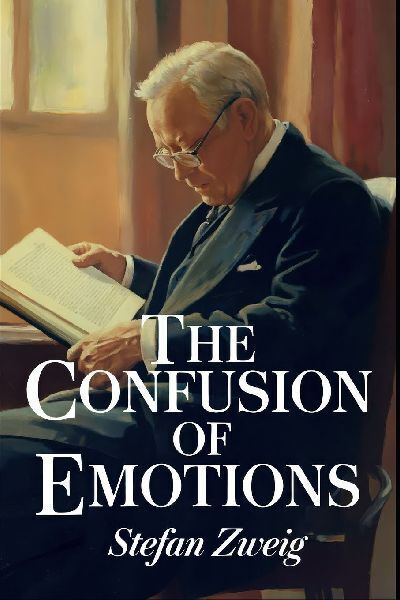
Roland is a young man without direction - sent by his father to a provincial university, indifferent to study, waiting for something he cannot name - when he encounters the professor whose lectures change everything. The man is extraordinary: a scholar who inhabits the literature he teaches, who makes intellectual life feel like something worth giving a life to. Roland is captivated. He moves into the professor's household. He becomes, over one semester, the center of a world he does not fully understand.He does not understand, in particular, why the professor sometimes burns with warmth toward him and sometimes withdraws into a coldness that feels like punishment. He does not understand the role the professor's wife plays, her particular kindness, the shadow in it. He does not, yet, understand himself.The Confusion of Emotions, first published in 1927, is Stefan Zweig at his most psychologically exact - a novella about repressed homosexual desire and the devastation it leaves in its wake, written with a compassion and a directness that were remarkable for their moment and have not aged by a day. It is narrated by an older Roland looking back on the episode that made him, finally understanding what he could not have understood at the time: what the professor was carrying, what concealment of that magnitude costs a person, and what it means to love someone you could not help.Zweig does not offer resolution. He offers something more honest: the portrait of a man who could not be what his world would not allow, and of the student who spent a lifetime trying to do justice to that fact.
| Reihe | Independently published |
|---|---|
| ISBN | 9798312503005 |
| Sprache | Englisch |
| Erscheinungsdatum | 28.02.2025 |
| Größe | 229 x 152 mm |
| Verlag | Independently published |
| Übersetzung | Liam Ferousse |
| Lieferzeit | Lieferung in 7-14 Werktagen |
| Herstellerangaben | Anzeigen Libri GmbH Europaallee 1 | D-36244 Bad Hersfeld gpsr@libri.de |
Wie gefällt Ihnen unser Shop?