GUTSCHEIN
Bitte haben Sie einen Moment Geduld, wir legen Ihr Produkt in den Warenkorb.
Diese Produkte könnten Sie auch interessieren:
Bitte haben Sie einen Moment Geduld, wir legen Ihr Produkt in den Warenkorb.
| Reihe | Schriftenreihe der Professur für Analytik und Technologie pflanzlicher Lebensmittel |
|---|---|
| Themen | Technologie, Ingenieurswissenschaft, Landwirtschaft, Industrieprozesse Industrielle Chemie und Fertigungstechnologien Industrielle Chemie und Chemietechnologie Lebensmittel- und Getränketechnologie |
| ISBN | 9783819109317 |
| Sprache | Englisch |
| Erscheinungsdatum | 16.10.2026 |
| Größe | 21 x 14.8 cm |
| Verlag | Shaker |
| Lieferzeit | Erscheint am 16.10.2026 |
| Herstellerangaben | Anzeigen Shaker Verlag GmbH Am Langen Graben 15a | DE-52353 Düren info@shaker.de |
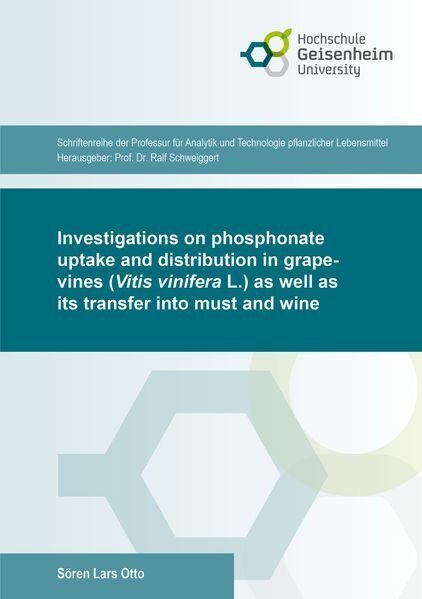
Organic viticulture faces the enormous challenge of controlling Plasmopara viticola, the causal agent of downy mildew. At the same time, the environmental burden associated with copper-based fungicides should be urgently reduced. Although effective against downy mildew, potassium phosphonates were banned in European organic viticulture in 2013, yet residues are still frequently detected in organically produced grapes and wines, raising questions about their origin, persistence, and regulatory interpretation. This thesis provides a comprehensive investigation of phosphonate behavior from grapevine to wine. A sensitive ion chromatography with inductively coupled plasma mass spectrometry (IC-ICP-MS) method was developed and validated for trace-level analysis in grapevine-derived matrices, achieving substantially lower limits of quantification than conventional ion chromatography with conductivity detection (IC-CD). A novel leaf-to-petiole index enabled differentiation between foliar and soil-derived uptake, providing a new approach for tracing residue origins. Vineyard and container studies revealed persistent phosphonate accumulation in grapevine tissues and showed that application regimes can influence residue levels. Vinification further showed only modest residue reductions during fermentation and fining and identified oenological processing aids as an additional contamination pathway. Collectively, these findings contribute to a more nuanced interpretation of phosphonate residues and their implications for organic viticulture, while supporting more sustainable plant protection strategies.
| Reihe | Schriftenreihe der Professur für Analytik und Technologie pflanzlicher Lebensmittel |
|---|---|
| Themen | Technologie, Ingenieurswissenschaft, Landwirtschaft, Industrieprozesse Industrielle Chemie und Fertigungstechnologien Industrielle Chemie und Chemietechnologie Lebensmittel- und Getränketechnologie |
| ISBN | 9783819109317 |
| Sprache | Englisch |
| Erscheinungsdatum | 16.10.2026 |
| Größe | 21 x 14.8 cm |
| Verlag | Shaker |
| Lieferzeit | Erscheint am 16.10.2026 |
| Herstellerangaben | Anzeigen Shaker Verlag GmbH Am Langen Graben 15a | DE-52353 Düren info@shaker.de |
Wie gefällt Ihnen unser Shop?